7,500 species in Antartica. 5,500 species in the Artic.
Who would have guessed there’d be such great biodiversity in the polar regions? Not most scientists!
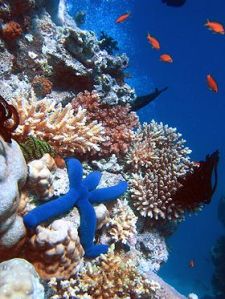
Most of us think biodiversity occurs in the rainforests, on coral reefs like the Great Barrier Reef (here’s a list of almost 8,000 species), or in places like the Galapagos islands and the Channel Islands. Not in the land of snow and ice where we, from our above ground vantage point, see little that looks like life. But it’s so!
 The results of new polar region surveys, released Monday, February 15 show that the Antarctic and the Arctic has a much greater biodiversity than ever before imagined, in the seas, like nearly 100 species of crustaceans.
Biodiversity, in case you need a quick brush-up, is “the variety of all forms of life, from genes to species, through to the broad scale of ecosystems,” explains the Stanford Encyclopedia of Philosophy. “The global importance of biodiversity now is reflected in the widely accepted target to achieve a significant reduction in the rate of loss of biodiversity by the year 2010.”
Why? you ask. Why is biodiversity important? There are a number of reasons, and a number of debates that I won’t get into in THIS post.
What I think is important to consider is that when we ask why is it important, we typically mean important to US –as in US HUMANS. As we move from being species centric to being more biodiversity centric, as we move from only seeing what has value to us human species, we recognizing that other species have value whether we understand it or not. For Wikipedia’s explanation of biodiversity, go here.
Finding so much biodiversity in the polar regions means we need now to be careful there of how our heavy human feet tread. As the polar ice caps melt and ice shelfs retreat, how will climate change further impact this area?
According to an article by AP environmental science writer Michael Casey,
“The textbooks have said there is less diversity at the poles than the tropics, but we found astonishing richness of marine life in the Antarctic and Arctic oceans,” said Victoria Wadley, a researcher from the Australian Antarctic Division who took part in the Antarctic survey. “We are rewriting the textbooks.” In one of the biggest surprises, researchers said they discovered dozens of species common to both polar seas — separated by nearly 7,000 miles (11,000 kilometers). Now they have to figure out how they separated.
“We probably know more about deep space than we do about the deep polar oceans in our own backyard,” said Gilly Llewellyn, leader of the oceans program for the environmental group WWF-Australia. She did not take part in the survey. “This critical research is helping reveal the amazing biodiversity of the polar regions.”
Read more…