Is the SEMICOLON Dead? Definitely Not! Long Live the SEMICOLON! And YOU!
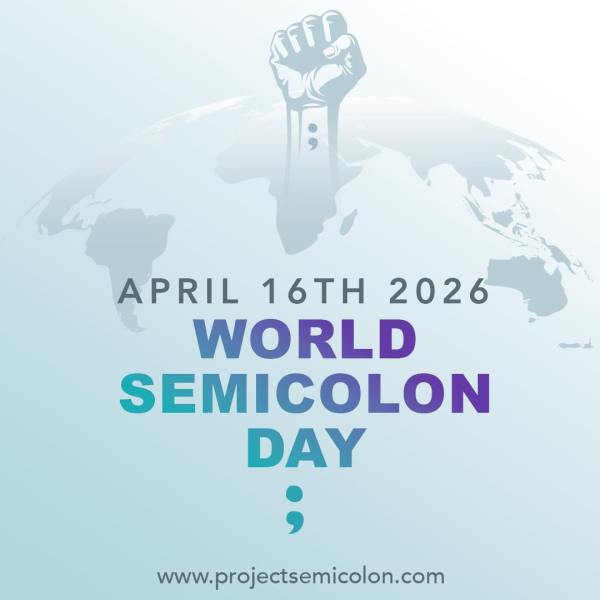
World Semi-Colon Day 2026
A week ago Wednesday I was on a private art tour in the hills above Santa Barbara where the landscape was studded with art including a few choice pieces of punctuation including a very large, 6′ tall semi-colon. “The semi-colon is dead,” said our docent quite matter of factly. “It was in the Times.” (Or was it the Post? Or NPR? Or all of the above ganging up on this beleaguered punctuation?)
Our group of artists and writers raised collective eyebrows in disbelief and grumbled a bit.
“No, it’s true,” said our friends who organized the tour. “We looked it up! we read it online.”
That night when I got home I did look it up, and found that several publications have declared that while not exactly dead, the semicolon is in danger of going extinct because, the articles claim, people don’t know how to use them — and people are enamored with the em dash.
- According to the Washington Post, the semicolon suffers from reduced usage– and they bring receipts.
- According to NPR in January 2026, semicolons are a “graceful pause” and are still used in specialized, technical, and academic writing to connect closely related, independent clauses or to separate a complex list.
- According to Readable in 2024, “the loss of the semicolon, then, is a loss of a certain kind of thinking. But to declare the semicolon extinct would be premature. While its use may be waning, its essence still lingers. Current writers haven’t forgotten the power of the pause.”
Further, Readable author Dave Child writes “the decline of the semicolon tells a deeper story. It reflects a shift in our relationship with time and thought. It was born in the Renaissance, a time of exploration and contemplation. The semicolon embodied pause and reflection. It held spaces for ideas to breathe. For connections to bloom between them. In Woolf’s words, it was a “pronounced pause”.”
Basically, a semicolon is a period on top of a comma, and indicates a pause, not an ending.
Personally, I find the semicolon a powerful punctuation tool that helps me express complex and linked ideas and helps me make meaning for my readers.
As a teacher of writing, when students have a comma splice, it can usually be fixed with a semicolon– they are splicing two complete sentences or ideas together with a comma — but they need the period on top to show that they are connecting two complete sentences.
To put it another way, the period shows us that the first part of the sentence is a complete idea –and it could function correctly and independently with a period at the end. The comma shows the reader that the two ideas are connected– the writer wants you to just take a minor pause to take in the ideas of the first part before moving on to the second part.
Huh? Run that again? Think of it this way:
The period shows where the author could end a sentence, but chose not to; instead the author includes a comma to show the link between the ideas– and that the author wants to continue the sentence.
For me to suggest a semicolon where a student has a comma splice is a less obtrusive way to correct punctuation– but not change meaning. I shared this strategy with a colleague the other day, and I swear I saw a lightbulb go off! Incorrect semicolon use used to be worse, but according to my students, this Oatmeal cartoon has helped them understand what a semi-colon is, what it does, and how to use it, so here is the link.
To me the semicolon is powerful for another reason, and I bring up semicolons today because April 16 is World Semicolon Day, a day for suicide prevention and awareness. The semicolon is a symbol of suicide awareness and prevention adopted by Project Semicolon. “Every day, thousands of people struggle with suicidal thoughts, attempt suicide, or are lost to it. Behind every number is a person, a family, and a moment that needed support sooner,” they state on their website. According to Project Semicolon, every day 36,164 people consider suicide while 4,383 people attempt suicide and 132 people die by suicide.
Founder Amy Bleuel said of the Project in 2015 that, “The semicolon was chosen because in literature a semicolon is used when an author chooses to not end a sentence, “You are the author and the sentence is your life. You are choosing to continue.” Bleuel struggled with depression after her dad died of suicide when she was 18; at 31, she took her own life.
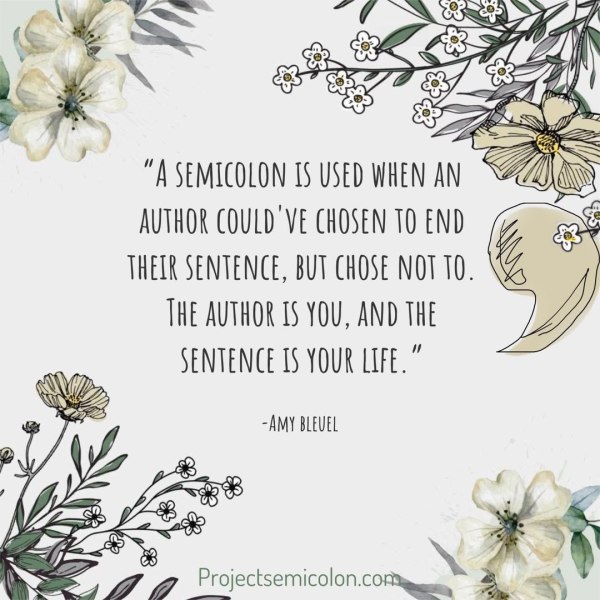
semicolon day
A semicolon is a pause — not an ending.A choice to continue, even when it’s hard.Your story isn’t over.
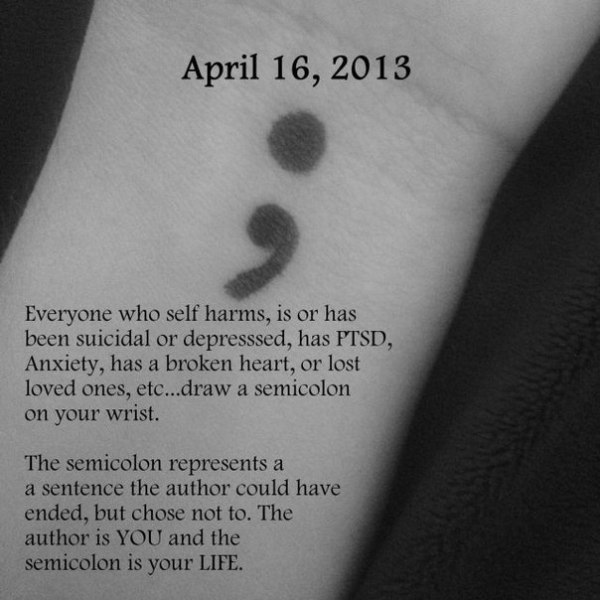
semicolon day
“Pay attention. Find the blessing. It’s passing. Everything is a gift and nothing lasts,” writes Erin Geesaman Rabke.
Most of us know people who have considered, attempted or committed suicide. While how my friends died and why matters, what’s important here is that they decided to no longer pay attention, to find the blessing, to remember that everything is temporary, that life is a gift, and nothing lasts. James Hillman taught me to look for the gift in the wound:
“The alchemists had an excellent image for the transformation of suffering and symptom into a value of the soul. A goal of the alchemical process was the pearl of great price. The pearl starts off as a bit of grit, a neurotic symptom or complaint, a bothersome irritant in one’s secret inside flesh, which no defensive shell can protect oneself from. This is coated over, worked at day in, day out, until the grit one day is a pearl; yet it still must be fished up from the depths and pried loose. Then when the grit is redeemed, it is worn. It must be worn on the warm skin to keep its luster: the redeemed complex which once caused suffering is exposed to public view as a virtue. The esoteric treasure gained through occult work becomes an exoteric splendor. To get rid of the symptom means to get rid of the chance to gain what may one day be of greatest value, even if at first an unbearable irritant, lowly, and disguised.” Read Hillman’s 1991 essay “In Search Of Soul”, an excerpt from his book A Blue Fire in The Sun.
For something completely different– a couple of videos courtesy of Weird Al and Big Bang Theory. (Speaking of Word Crimes, I thought it was semi-colon not semicolon…those hyphens get me every time!)

passing
About the art above: Leslie Rinchen-Wongmo is a textile artist, teacher, author of Threads of Awakening: An American Woman’s Journey into Tibet’s Sacred Textile Art, and one of few non-Tibetan artists of silk appliqué thangka.
Discover more from art predator
Subscribe to get the latest posts sent to your email.