Skip to content

Biodiversity: Islands of the Great Barrier Reef, Galapagos Islands, Channel Islands, rainforests–and polar regions????

February 20, 2009

7,500 species in Antartica. 5,500 species in the Artic.

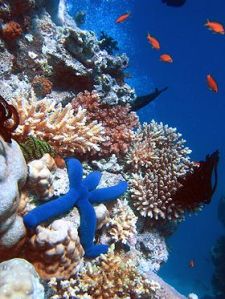
280px-blue_linckia_starfish1

Who would have guessed there’d be such great biodiversity in the polar regions? Not most scientists!

Most of us think biodiversity occurs in the rainforests,  on coral reefs like the Great Barrier Reef (here’s a list of almost 8,000 species), or in places like the Galapagos islands and the Channel Islands. Not in the land of snow and ice where we, from our above ground vantage point, see little that looks like life. But it’s so!

300px-polar_bears_near_north_pole from http://en.wikipedia.org/wiki/BiodiversityThe results of new polar region surveys, released Monday, February 15 show that the Antarctic and the Arctic has a much greater biodiversity than ever before imagined, in the seas, like nearly 100 species of crustaceans.

Biodiversity, in case you need a quick brush-up, is “the variety of all forms of life, from genes to species, through to the broad scale of ecosystems,” explains the Stanford Encyclopedia of Philosophy. “The global importance of biodiversity now is reflected in the widely accepted target to achieve a significant reduction in the rate of loss of biodiversity by the year 2010.”

Why? you ask. Why is biodiversity important? There are a number of reasons, and a number of debates that I won’t get into in THIS post.

What I think is important to consider is that when we ask why is it important, we typically mean important to US –as in US HUMANS. As we move from being species centric to being more biodiversity centric, as we move from only seeing what has value to us human species, we recognizing that other species have value whether we understand it or not. For Wikipedia’s explanation of  biodiversity, go here.

Finding so much biodiversity in the polar regions means we need now to be careful there of how our heavy human feet tread. As the polar ice caps melt and ice shelfs retreat, how will climate change further impact this area?

According to an article by AP environmental science writer Michael Casey,

“The textbooks have said there is less diversity at the poles than the tropics, but we found astonishing richness of marine life in the Antarctic and Arctic oceans,” said Victoria Wadley, a researcher from the Australian Antarctic Division who took part in the Antarctic survey. “We are rewriting the textbooks.” In one of the biggest surprises, researchers said they discovered dozens of species common to both polar seas — separated by nearly 7,000 miles (11,000 kilometers). Now they have to figure out how they separated.

“We probably know more about deep space than we do about the deep polar oceans in our own backyard,” said Gilly Llewellyn, leader of the oceans program for the environmental group WWF-Australia. She did not take part in the survey. “This critical research is helping reveal the amazing biodiversity of the polar regions.”

The article continues: Most of the new discoveries were simpler life forms known as invertebrates, or animals without backbones.

Researchers found scores of sea spider species that were as big as a human hand, and tiny, shrimp-like crustaceans in the Arctic basin that live at a depth of 9,850 feet (3,000 meters).

The survey is one of several projects of the Census of Marine Life, an international effort to catalog all life in the oceans. The 10-year census, scheduled for final publication in 2010, is supported by governments, divisions of the United Nations and private conservation organizations.

The survey — which included over 500 polar researchers from 25 countries — took place during International Polar Year which ran in 2007-2008.

Researchers endured up to 48-foot (16-meter) waves on their trip to the Antarctic, while their colleagues in the Arctic worked under the watchful eye of a security guard hired to protect them from polar bears.

New technology also helped make the expeditions more efficient and productive than in the past. Researchers used cell-phone-like tracking devices to record the Arctic migration of narwhals, a whale with a long twisted tooth, and remotely operated submersibles to reach several miles (kilometers) down into the oceans to study delicate marine animals that are impossible to collect.

As many as 235 species were found in both polar seas, including five whale species, six sea birds and nearly 100 species of crustaceans.

“We think of the Arctic and Antarctic as similar habitats but they are separated by great distances,” said University of Alaska Fairbanks plankton ecologist Russ Hopcroft, who took part in the Arctic survey.

“So finding species at both ends of the Earth — some of which don’t have a known connection in between — raises a whole bunch of evolutionary questions,” he said.

Hopcroft and other polar researchers will now try to determine how long these species have been separated and whether they have drifted apart genetically.

David Barnes, of the British Antarctic Survey, said there a number of possibilities to explain how similar species live so far apart.

Some may have traveled along the deep-sea currents that link the poles or may have thrived during the height of the last ice age about 20,000 years ago when the polar environment was expanded and the two habitats were closer.

Hopcroft and Barnes cautioned that more work needs to be done to confirm whether the 235 species are indeed the same or differ genetically.

“Painstaking work by geneticists investigating both nuclear and mitochondrial genes will only be able to confirm this,” Barnes said in an e-mail interview. “It may be they separated sometime ago but similar selective pressures have meant they have not changed much.”

___

On the Net:

Census of Marine Life: http://www.coml.org

Arctic Ocean Diversity: http://www.arcodiv.org.

Census of Antarctic Marine Life: http://www.caml.aq

http://news.yahoo.com/s/ap/20090215/ap_on_sc/as_antarctica_bountiful_sea

http://www.environment.gov.au/biodiversity/publications/greenhouse/ and climate change

Photos from http://en.wikipedia.org/wiki/Biodiversity


Discover more from art predator

Subscribe to get the latest posts sent to your email.

4 Comments leave one →
  1. Crafty Green Poet's avatar
    February 20, 2009 7:38 am

    very interesting post, thanks. Just shows how much there is still to doscover…

  2. throughstones's avatar
    February 20, 2009 7:20 pm

    What an inspiring and exciting blog! Have they given you the job yet? I don’t see how they can refuse!

  3. Lawman2's avatar
    February 20, 2009 9:06 pm

    As always art predatar, i enjoyed the post!makes me want to go see and explore it all myself!

  4. Gwendolyn Alley aka Art Predator's avatar
    February 21, 2009 3:37 am

    No, Throughstones, they haven’t given me the job yet! It’s a long long long row to hoe and my video isn’t even officially up on the site yet! But thank you, and I agree!

    Yay, Lawman, that’s one of my goals–to get people out and about and exploring!!

    Yes, Juliet–and that’s saying a lot from you since you do get out and about a bit!

    Will let you all know when the video is ofically up so you can go rate it 5 stars!

Leave a comment

Discover more from art predator

Subscribe now to keep reading and get access to the full archive.

Continue reading

Crushed Grape Chronicles

Adventures in Wine Exploration

The Wine Rules

Shining a light on the wine industry

CabbieBlog

Taxi Talk Without Tipping

Jack Elliott's Santa Barbara Adventure

. . .tales from one man's wanderings, regional insight and history

The magical world of wines from Grocery Outlet

The best and the worst of Gross Out.

Stephen McConnell

A Daily Journal of Fruit, Structure, Varietal honesty, and Balance.

Sonoran Images

Photography by Steven Kessel

SpitBucket

Diary of a Wine Student

Syrah Queen

Wine, Food & Travel Resource

The Paper Plane Journey

About my passion for wine and travel

Briscoe Bites

Booze, Baking, Big Bites and More!

Mythology Matters

Matters of Myth, and Why Myth Matters

Smith-Madrone News

Good Thoughts & Great Wine from Spring Mountain, Napa Valley

Fueled by Coffee

Lifestyle, food, parenting, DYI

Bottled Bliss

Day-colored wine, night-colored wine, wine with purple feet...

Do Bianchi

Negotiating the epistemologic implications of italocentric oenophilia.

deborahparkerwong

Global wine culture

Elizabeth Gabay MW

Wine, Food and History: from the Rhone to Piedmont

Budget Trek Kashmir

Kashmir Great Alpine Lakes Trek - Trek Guide

Oldfield's Wanderings

Objects in blog are closer than they appear

Memorable Moments

With Lists & Adventures That Keep Life Interesting

Vinos y Pasiones - 10 años

Aprender, comunicar y profesionalizar el mundo del vino, la gastronomía y el enoturismo con mirada experta.

Best Tanzania Travel Guides

from Kilimanjaro to the Serengeti and beyond

LUCAS GILBERT

The Best Guide in Tanzania

Pull That Cork

Wine makes our life more fun.

Always Ravenous

Adventures in Food and Wine

Joy of Wine

"Wine cheereth God and man." -- Judges 9:13

Side Hustle Wino

If you're not having fun, you're not doing right.

Vineyard Son Alegre

Organic Wine And Olive Oil From Santanyí, Mallorca (Spain)

Lyn M. (L.M.) Archer

storyteller | image-maker

What's in that Bottle?

Better Living Through Better Wine!

ENOFYLZ

My humble wine blog

PostSecret

Discover true secrets that have never been shared. Explore the surprising stories behind the secrets.

foodwineclick

When food and wine click!

The Flavor of Grace

Helene Kremer's The Flavor of Grace

The Swirling Dervish

Wine Stories, Food Pairings, and Life Adventures

ENOFYLZ Wine Blog

Living La Vida Vino!

Dracaena Wines

Our Wines + Your Moments = Great Memories

Sonya Huber

books, essays, etc.