On the Death of Blogging, Bertrand Russell, Ben Franklin, Hugh McLeod & Jason Calacanis

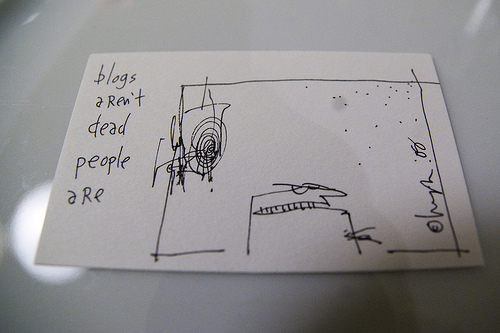
cartoon by Hugh McLeod of Gaping Void
Hugh McLeod drew the cartoon above at the Blog 08 conference in Amsterdam last month as a response to the October 20 Wired article by Paul Boutin which tells people to pull the plug on their personal blogs because they just can’t compete with professionally written sites like Huffington Post:
Writing a weblog today isn’t the bright idea it was four years ago. The blogosphere, once a freshwater oasis of folksy self-expression and clever thought, has been flooded by a tsunami of paid bilge. Cut-rate journalists and underground marketing campaigns now drown out the authentic voices of amateur wordsmiths. It’s almost impossible to get noticed, except by hecklers. And why bother? The time it takes to craft sharp, witty blog prose is better spent expressing yourself on Flickr, Facebook, or Twitter.
If you quit now, you’re in good company. Notorious chatterbox Jason Calacanis made millions from his Weblogs network. But he flat-out retired his own blog in July. “Blogging is simply too big, too impersonal, and lacks the intimacy that drew me to it,” he wrote in his final post.
Instead, he suggests people use Facebook, Twitter and Flickr, and revel in the brevity of 140 character posts like this one which he wrote to summarize his article:
@WiredReader: Kill yr blog. 2004 over. Google won’t find you. Too much cruft from HuffPo, NYT. Commenters are tards. C u on Facebook?
I know from talking with bloggers and twitter users at the Wine Blogging Conference that not being on Twitter left me out of a lot of the converation. But while they were twittering, I was having face to face conversations, and there’s definitely value in that for me.
I disagree also with his basic premise that it is impossible for the random personal blogger like me to get readers or for people to find their blogs using search engines. I was a top source this election on several political topics: for example, my post on a PBS poll and my post “Not Waving but Drowning” which debunked a viral conservative email were both on the first page in the search engines and sent me a lot of readers (308 page views on the poll and 225 for “Drowning”). My post about the lunar eclipse last February also topped the page on Google and other search engines and to date has had 4,840 views to date, and my post about Chris Ringland’s Ebenezer shiraz 2006 has had 907. Art Predator is growing steadily; I’m averaging over 150 views a day for October and November.
Yep, not bad for a personal blog that started out being about poetry, art, travel, and being a Burning Mom. I think I’ll keep at it, Wired be hanged. Oh and Jason Calacanis? He posted on his blog Nov. 5…
@import “http://66.249.28.33/~blog//mambots/content/plugin_jw_ts/tabs_slides.css”; .jwts_tabbernav{display:none;} var jwts_slideSpeed=30; var jwts_timer=10; .jwts_tabber{display:none;}
| Important Blogging Statistics |  |
 |
|
Discover more from art predator
Subscribe to get the latest posts sent to your email.

















 art predator
It a great result and just reward for intelligence, creativity and honesty. I saw this article in Wired and it is part of the debate about whether content is required. Facebook and twitter are great ways to gets lots of followers and be famous for beinf famous. Blogs require content. Also check out the corporate allgience of the magazine and the writer of the article. It is not journalism it is propaganda advertising for two big coorporate motherfuckers against the independants. But that’s just my point of view. Try expressing that in Wired.com.
I agree with Paul- but what about writing for the mere pleasure of writing? Being read is secondary- you do it first of all because it simply keeps you out of trouble and is a source of personal pleasure. The great thing about the blog- there is the possibility that a stranger may read what you have written.
I think part of what the Wired author is arguing is that it is harder for the ave joe to provide that great content–and that more and more of the bloggoshere is filled with content filled by hacks, journalists, and people out to make a buck which makes it less satisfying to read.
And that if the ave Joe or Paul pr Randall or poet is providing great content, it is too hard to fin.
As we 3 know, however, there is great content out there and it is worth finding. But you both admit there is a lot of dreck to wade through.
Good point, Paul, that twitter etc with 140 words offers little in the way of content. I don’t need to know what most people have for lunch (I do make an exception for you, Paul).
And I absolutely agree with you, Randall, that it is important to have your goals in mind–is it to write and be able to put it somewhere and the fact that someone might stumble upon it, read it, adn get something out of it is a bonus to the intrinsic pleasure of writing??
thanks, guys, for your comments and for making me thinking more about this…